Restaurant loyalty program: McDonald's 5 decisions
At the end of 2014, McDonald’s CEO Don Thompson summed up the year in one sentence: “2014 was a challenging year for McDonald’s around the world.” Net income was down 15%, comparable sales were falling globally, and U.S. guest traffic had been declining for years. In 2015 the company closed 154 U.S. restaurants and opened 63; its U.S. restaurant count shrank for the first time since at least 1970.
Ten years on, the picture is reversed, and what made the growth stick was not a new burger but the loyalty app launched in 2021: in 2025 roughly a quarter of McDonald’s $139 billion in systemwide sales came from loyalty members. This post breaks that program into five decisions. It is written as a loyalty program example for cafe and restaurant operators, with one branch or five, who are planning a restaurant loyalty program of their own: what to copy, and what to leave behind.
What happened in 2014?
| Indicator | 2014 | 2025 |
|---|---|---|
| Global comparable sales | down 1.0% | up 3.1% |
| Net income | $4.76 billion (down 15%) | $8.56 billion (up 4%) |
| Systemwide sales to loyalty members | No program | About $37 billion |
| 90-day active loyalty members | No program | About 210 million |
Source: McDonald’s 2014 and 2025 full-year results.
The real indicator of the decline was not revenue but the number of people walking in. U.S. guest traffic fell 4.1% in 2014 and 3% in 2015, and 2016 opened as the fourth year of decline. The 2015 U.S. closure and opening counts are in BuzzFeed News; Fortune had already called the U.S. contraction, mid-year, a first since at least 1970.
Nothing was wrong with the menu. The problem was that customers came less often, and the company had no idea who those customers were.
Did the loyalty program save McDonald’s?
Not in 2015. This deserves to be said plainly: Steve Easterbrook replaced Thompson in March 2015 and his first moves were operational: a simpler menu, faster service and all-day breakfast. That stopped the bleeding. The loyalty program arrived six years later and turned a stopped bleed into growth.
The app side moved slowly and deliberately:
- 2015. An app exists, but it is a menu, weekly deals and a store finder: a coupon book.
- 2017. Mobile Order and Pay rolls out to 14,000 U.S. restaurants and 6,000 more in six other countries by year end. The app produces transactions for the first time.
- 2019. McDonald’s buys the personalization engine Dynamic Yield for more than $300 million. First use: drive-thru menu boards that change with the time of day, the weather and how busy the restaurant is.
- November 2020. The “Accelerating the Arches” strategy is built on three Ds: Digital, Delivery, Drive Thru. The MyMcDonald’s platform and the coming loyalty program are announced in this document.
- 8 July 2021. MyMcDonald’s Rewards goes live across the U.S., the first loyalty program in the brand’s history.
The order matters. The app existed for six years and built no customer record. The moment loyalty was added, every order was tied to a name. Paper coupons and tray-liner sweepstakes drove sales for decades, and none of them ever answered the question “when did this customer last come in”.
What the program delivered, year by year
McDonald’s reports the program to investors with two numbers: members who transacted at least once in the last 90 days, and systemwide sales to those members.
| Period | 90-day active members | Annual systemwide sales to loyalty members | Markets |
|---|---|---|---|
| December 2023 | 150 million | $20 billion | 50 |
| End of 2024 | Over 175 million | About $30 billion | 60 |
| End of 2025 | About 210 million | About $37 billion | 70 |
| June 2026 | About 220 million | $40 billion (twelve months to June 2026) | 70 |
| 2027 target (announced December 2023) | 250 million | $45 billion |
Sources: December 2023 investor update, 2024 and 2025 full-year results, Q2 2026 results. Some trade publications quote “about $40 billion” for 2025; the table uses the company’s own figure, and the $40 billion belongs to the twelve months ending June 2026.
In two and a half years, active members grew 47% and loyalty sales doubled. In 2025 those members accounted for about 27% of $139 billion in total systemwide sales (our calculation, the ratio of two official figures). CFO Ian Borden called active loyalty members the company’s “single most important digital metric” in February 2026.
How a customer loyalty program grows revenue: frequency, not discounts
The program’s most important number is not in the table above. On the Q2 2025 earnings call, CEO Chris Kempczinski drew this comparison: U.S. loyalty members visit 26 times a year, non-members about 10.5. On the same call he described the plan as “frequency-led growth”.
Read that number carefully. It is the average of two different groups, not the same customer before and after joining, and customers who already visit often are the ones most likely to join. So the whole 2.5x gap is not the program’s doing. McDonald’s still builds its growth on that gap, because the goal is not to collect members but to bring members in more often. According to Kempczinski, about a quarter of McDonald’s own U.S. customers are in the program.
Discounts play a smaller part than people assume. A chain that hands out coupons had been handing out coupons for years. What changed is that the customer is now recognized and reachable: the offer goes to the right person, at the right hour, on their own phone. New customers come from advertising; an existing customer’s next visit comes from being recognized. That is what customer retention means in practice: knowing the customer and triggering the next visit.
The same logic works at small scale, with more modest numbers. A simple unit calculation, with example figures: in a cafe with an average ticket of 180 TL, one extra visit a month from an active member is 12 × 180 = 2,160 TL a year. If 200 of 800 registered members are active, that is 432,000 TL of additional revenue a year. That is a gross figure: reward cost is charged on all member spend, not only on these extra visits, and food cost is separate; run that part of the calculation with your own reward rate. The untested variable here is “one extra visit a month”: you find your own figure by comparing a member cohort’s visit frequency before and after joining. Swap in your own ticket and active-member count too; the result changes, the logic does not.
McDonald’s as a loyalty program example: five decisions
1. Is every transaction identified?
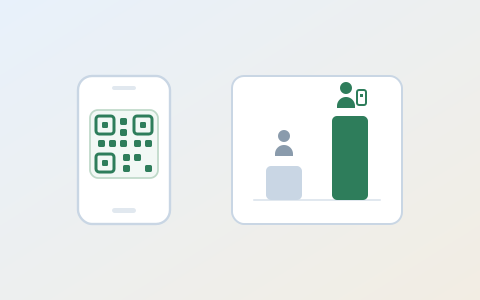
To earn points the transaction has to touch the app: either an order placed in the app, or the app’s QR code scanned at the counter, at the kiosk or at the drive-thru. McDonald’s Türkiye’s MyM Ödüllerim program works the same way: the QR code in the MyM tab is scanned and points land on the account. No identity, no data; no data, no personalization. Everything starts at this step.
2. The points system: how far away should the first reward be?
In the U.S. every dollar earns 100 points and the first reward starts at 1,500 points, so roughly $15 of spend unlocks the first free item. At launch the first order carried a 1,500-point bonus, so the first reward was effectively the first order. In the Turkish program, too, the reward menu starts with a small drink and runs up to a full meal. The lesson is plain: the first reward should be two or three visits away. A reward that arrives in three months is, for most customers, a reward that never arrives.
3. Does the offer fit the person?
This was the reason for the Dynamic Yield purchase; McDonald’s sold the company to Mastercard at the end of 2021 and kept using the engine. The person who buys coffee at 8 a.m. does not get a dinner discount; the person last seen three weeks ago gets a different offer from a brand-new member. That requires order history tied to a name, so there is no decision three without decision one.
4. Is there a reason to open the app?
The Monopoly promotion was played about 500 million times inside the app in 2025. Progress bars, streaks and prize draws in the app replaced collecting paper game pieces. Play gives people a reason to open the app, and every open is an ordering opportunity.
5. Which metric: registered members or active members?
McDonald’s does not report total registered members. It reports members who transacted in the last 90 days. Someone who signed up and never came back is not in that number. Under the Turkish program’s terms of use, points are wiped about a year after they are earned and an account can hold at most 20,000 points at any time; both rules push members to spend and return rather than hoard.
Should delivery-platform orders earn points?
McDonald’s Türkiye’s program terms answer this clearly for themselves: campaigns cannot be used with the delivery service, only in the restaurant at the counter, at the kiosk or at the drive-thru. The reward stays in the company’s own channel.
For a restaurant in Türkiye this question matters more than it does for McDonald’s, because on an order that arrives through a food-delivery platform the customer is the platform’s, not yours: the name, the number and the order history sit with the platform, while the commission sits with you. This is where the “every transaction identified” principle leaks the most. There are two reasonable routes: keep platform orders outside the program, or admit the platform customer with an offer that moves them to your own channel (WebApp, phone, the branch). Giving a platform order the same points as your own channel means rewarding, out of your own pocket, the channel you already pay commission on.
How is a restaurant loyalty program different in Türkiye?
Your customers already know the gesture. The same program runs in Türkiye, and scanning a QR code at the till is no longer unfamiliar behavior. Your program does not have to teach that habit from scratch.
Discount fatigue is real. Turkish consumers are used to coupon codes, coalition loyalty apps and permanent promotions. A program built on discounts alone competes with everyone else’s discount. McDonald’s edge was not the size of the discount but recognizing the customer and reaching them at the right moment. This is where small scale is an advantage: knowing the customer is easier in one branch or five than across a national chain.
KVKK already points at QR at the till. Decision 2026/266 of the Turkish Personal Data Protection Board requires loyalty programs to verify that the person transacting is the cardholder. The decision’s six-month window was extended to 28 February 2027 by decision 2026/1491. One of the methods the decision names as an example is scanning a QR code through a mobile app or website. So McDonald’s flow at the counter is also the shape of the verification step every business running a loyalty program in Türkiye will need next year. Details and a comparison of methods are in the KVKK loyalty verification post.
You cannot afford to demand an install. McDonald’s has the ad budget and the visit frequency to get an app installed from the App Store. For a five-branch chain the install step is a threshold that loses a share of members before they start; which option makes sense for which business is the subject of Mobile App or WebApp. A browser-based WebApp that needs no installation gives the same QR flow without the install step. A Mobile App published on the stores can be added later; in Bonobo it is offered as an add-on.
Where this sits in Bonobo
Each of the five decisions can be built, at a different scale, with standard loyalty software features. Where each decision sits in Bonobo:
| Decision | In Bonobo | Plan |
|---|---|---|
| 1. Every transaction identified | QR recognition in the branded WebApp; POS integration for basket-level data | WebApp: all plans. POS integration: Connected, Connected Pro |
| 2. First reward close | Points, punch card, coupons and product-based rewards | Lite: points and coupons. Connected: one mechanic, points or punch card. Connected Pro: both together, plus product-based rewards |
| 3. Offers that fit the person | Smart Segmentation with Smart Campaigns; birthday, anniversary and win-back automations | Birthday, anniversary and win-back automations: all plans. Member segmentation and personalized campaigns: Connected and Connected Pro. The Smart Campaigns rule engine: limited on Lite and Connected, full scope on Connected Pro. Smart Segmentation, the RFM engine with industry templates: Connected Pro |
| 4. A reason to open the app | Push notifications, progress bar and membership tiers | Push: Connected and Connected Pro. Progress bar and tiers: Connected Pro |
| 5. One metric: active members | Member management (filtering and search), dashboard and standard reports | All plans |
You can start without POS integration: Lite runs without a connection to the register and comes with the branded WebApp, points and coupons, and birthday and “come back soon” automations. Where a POS-free design is enough and where it is not is the subject of loyalty program: is POS integration required?. Which plan fits which business is a separate question; you can see the plans and prices, or we can review your own flow together in 20 minutes.
Three steps you can take this week
1. Pick one metric: 90-day active members. Registered members is a vanity number. Whatever software you use, write down the number of members who transacted in the last 90 days every month; the program is working when that number grows. The three numbers to put beside it are in 4 KPIs for restaurant loyalty programs.
2. Put the first reward two or three visits away. Even “buy 10, get the 11th free” puts the first reward ten visits out. A small gift within the first three visits, then the main mechanic.
3. Automate one win-back flow. A message to anyone silent for 30 days, a small gift at 60, a last offer at 90. In Bonobo the win-back automation exists on all three plans and is listed as a ready-made playbook on the Smart Campaigns page; the rule engine runs in limited scope on Lite and Connected and in full on Connected Pro. McDonald’s 26 visits are the sum of hundreds of flows like this; for you, even one makes a measurable difference.
Let’s review your program against these five decisions together in 20 minutes. We look at your current flow and tell you what is missing, no commitment: request a demo. Still at the research stage? The next stop is the Lite page, which walks through QR recognition at the till.
Summary
- McDonald’s lost 15% of its profit in 2014, watched U.S. guest traffic fall for years, and in 2015 closed more U.S. restaurants than it opened
- The turnaround began with operations in 2015; the loyalty program launched in 2021 made the growth stick
- The program now reaches about 220 million active members in 70 markets and $40 billion in annual sales, with a target of 250 million members by 2027
- The real gain is visit frequency, not discounts: members visit 26 times a year, non-members about 10.5 (two groups’ averages, not the same customer before and after)
- Five decisions: every transaction identified, first reward close, offers fitted to the person, a reason to open the app, and 90-day active members as the one metric
- On a delivery-platform order the customer belongs to the platform; keep the reward in your own channel
- In Türkiye the QR flow at the till is both the gesture customers already know and one of the example methods in KVKK’s 2027 verification requirement
- A small chain’s advantage is recognition; its gap is the power to get an app installed, and the answer is a WebApp that needs no installation
The McDonald’s figures in this post come from the company’s own results announcements, the program rules from the program page and terms of use published by McDonald’s Türkiye, and the rest from the linked news sources; last checked 9 September 2026. Figures are systemwide sales in U.S. dollars (total sales of company-operated and franchised restaurants), not McDonald’s own revenue.